What Is a Crypto Payment Gateway? How It Works in 2026
Most people think a crypto payment gateway is just a wallet address pasted onto a checkout page. Honestly, that is the first idea worth fixing. A wallet address will not let you know what order it was
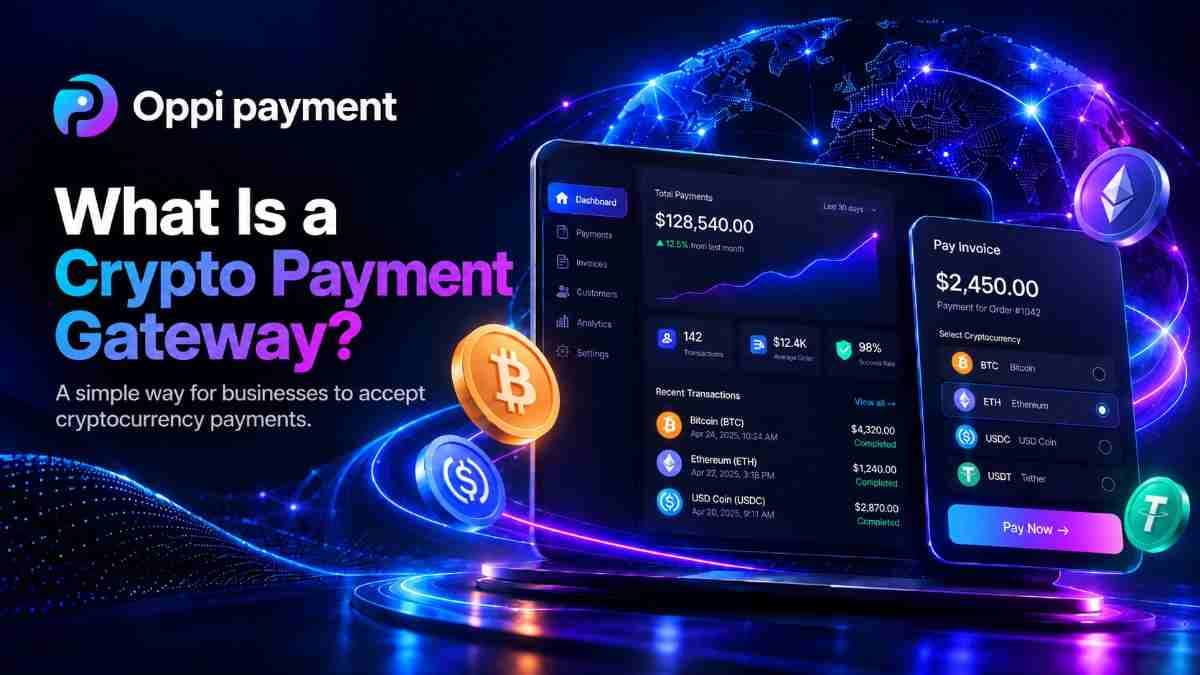
Most people think a crypto payment gateway is just a wallet address pasted onto a checkout page. Honestly, that is the first idea worth fixing. A wallet address will not let you know what order it was paid, whether it was the proper quantity, or when it's safe to ship the goods.
So, what is a crypto payment gateway?
A crypto payment gateway is software which enables a business to receive cryptocurrency as payment. It generates a request for payment to the exact amount of cryptocurrency, monitors the blockchain until the transaction is found, verifies that it is complete, and informs your store that the order has been paid. In simple terms, a blockchain is a public, shared ledger that stores each cryptocurrency transaction, ensuring that no one can manipulate it later on.
According to a survey conducted by PayPal and National Cryptocurrency Association (NCA) with The Harris Poll, 39% of US merchants already accept cryptocurrency, and 84% anticipate that it will be commonplace in the next 5 years. But on the customer side, the National Cryptocurrency Association reported that the 2026 state of crypto holders report shows that over 67 million adult Americans, or approximately 1 in 4, own crypto.
In this guide we will go through the process of how a gateway works and offer a step-by-step explanation for how it differs from a wallet or card gateway, how much a gateway costs in 2026, and which rules are important. You do not need any technical background to follow along.
1. What Is a Crypto Payment Gateway?
A crypto payment gateway is the connection that bridges the gap between your customers' crypto wallet and your business. If you're not used to it, imagine you work as a cashier. The cashier checks the cash, rings the order and gives the receipt. A wallet is just where the money goes.
Every payment goes through a gateway which performs a set of operations, including:
-
Prices the order. Converts your dollar or euro currency into the correct number of cryptocurrency.
-
Matches the payment. It ties each incoming transfer to the right order, usually with a unique address or payment reference.
-
Verifies the transfer. It waits until the blockchain verifies that the payment isn't fake and that it will be final.
-
Reports the result. Updates store, invoice, or dashboard to indicate that an order has been paid.
-
Settles the funds. It transfers funds to you in either crypto or you have to convert it into regular cash.
A quick note on words. Cryptocurrency is any currency which exists digitally and circulates through a blockchain, such as Bitcoin. Many businesses prefer crypto that has a steady value; this is where a stablecoin comes in, as it is a crypto with a fixed value, in this case, one dollar.
Why not skip the gateway and just share a wallet address? Because if you sell 50 items a day, then someone has to match 50 transfers to 50 orders by hand. A gateway does that matching automatically, whereas a plain wallet leaves it all to you.
It is easy to see that the number one thing is that a wallet receives crypto and a gateway transforms the received crypto into a completed sale that can be tracked!

2. How Is a Crypto Payment Gateway Different From a Wallet, an Exchange, or a Card Gateway?
The four of these tools are constantly confused, because they all involve money and they all include payment or crypto in the title. They have vastly different occupations, however. This table shows the split at a glance.
|
Tool |
Main job |
Who holds the money |
Typical user |
|
Crypto wallet |
Holds, send and receives cryptocurrencies |
You (self-custody) or the wallet provider (hosted wallet) |
Anyone |
|
Crypto exchange |
Buys, sells, and swaps crypto |
The exchange, in most cases |
Traders and investors |
|
Card payment gateway |
Passes card details safely from checkout to the payment processor |
Not the gateway itself; funds move through banks and processors |
Merchants |
|
Crypto payment gateway |
Prices, detects, confirms, and reports crypto payments, then settles them |
Depends on the type of gateway (see below) |
Merchants |
Is a crypto payment processor the same as a crypto payment gateway?
Not exactly, but the two terms overlap a lot. The front door is a gateway, checkout, request payment, and confirmation. A processor is the part that moves and settles the funds. In card payments, these are often two separate companies. In crypto, one provider usually does both, so a "crypto payment processor" on a website generally describes the same kind of service you are reading about here.
In short, if a provider takes the payment, confirms it, and gets the funds to you, you can treat it as both.
3. How Does a Crypto Payment Gateway Work?
You might think that cryptocurrency payments could be complicated for users. However, the majority of the processing occurs behind the scenes, making the checkout experience similar to a traditional one. Here is how a crypto payment gateway works, from click to cash-in.
-
The customer chooses crypto at checkout. They pick a coin and a network. A network is the blockchain that carries the coin, for example USDT (a stablecoin) on the Tron network.
-
The gateway creates a payment request. It displays an exact crypto amount and a wallet address or QR code. Many gateways generate a new address or reference number for each order, where that is where the payment would find its way to the right order.
-
The price is locked for a short time. Cryptocurrencies fluctuate in price and the gateway quotes a price and maintains it. If the customer fails to pay on time, it will be considered withdrawn and a new quote will need to be requested.
-
The customer sends the payment. Their wallet broadcasts the transfer to the blockchain. They also pay a small network fee, often called a gas fee, to the blockchain itself. This is separate from any fee the gateway charges.
-
The gateway detects the transfer. It monitors the blockchain and records it as seen when it is posted.
-
The network confirms it. A confirmation locks a new block of records on top of the payment making it more difficult to reverse. It is up to each gateway to determine what number of confirmations is final.
-
The gateway updates your store. Your order/invoice or dashboard status changes from "Order" to "Paid," and you can be sure the order is safe to ship or deliver.
-
The funds are settled. You receive the money either as cryptocurrency in your wallet or as regular currency after conversion by the provider.
To simplify crypto payment processing for businesses, explore crypto payment infrastructure solution. It enables businesses to grasp how the key elements of crypto payment processing function collectively, ranging from payment acceptance to settlement and transaction tracking.
What does a crypto checkout gateway look like to the customer?
A crypto checkout gateway is the section that your customer actually sees. It may be a hosted payment page or a pay button, invoice link or plugin within your online store. The amount due will often appear on the screen, along with a QR code to scan with a wallet application and a countdown timer counting down the locked price.
What happens if a customer pays too little or too much?
This is one of the most common questions, and it comes up more than people expect. Many customers pay from an exchange account, and exchanges often subtract their own withdrawal fee, so the amount that arrives is slightly short. Gateways handle it in different ways:
This is one of the most frequently asked questions, and it's certainly more than people are likely to think. Many customers deposit from an exchange and exchanges often subtract their own withdrawal fee, which means that the deposits received are somewhat lower. It's treated differently at each gateway:
-
Underpayment: Some gateways refund the shortfall. Others let you set a small tolerance. So an order will still proceed even if the payment falls slightly short.
-
Overpayment: Common method is to mark the order as fully paid and then return any extra amount to the customer.
-
Wrong network: When a customer attempts to send a coin to an address that isn't compatible with the network, those funds can be permanently lost. That's why a reliable checkout process clearly displays the network name.
In short, matching and finality are the true functions of a gateway, and not simply receipt.
4. What Types of Crypto Payment Gateways Are There?
All crypto payment gateways accept payments and notify you, but they vary in three aspects that are important to a business: who will have the funds, the currency you'll receive, and who will be operating the checkout. Understanding these three differences will give you the confidence to navigate any provider's website.
Custodial or non-custodial: who holds your money?
The definition of custody is simply holding money for somebody else. The payment will be deposited into wallets that are under the control of the gateway, and the gateway will pay out to you later. If it's a non-custodial gateway, the payment will be deposited into your wallet. The gateway never stores your private key, which are the secret codes that control a wallet, and it never holds your balance.
Non-custodial does not mean that there is no company behind the service. It indicates that the company does not keep your money as it processes the payment.
Do you receive crypto or regular money? The custody window
You might assume that getting paid in dollars or euros is just a default. It is actually a big architectural choice. If you want cash in your bank account, someone has to sell the crypto first, so the provider must hold the coins at least briefly during that conversion. We call that holding period the custody window. In this period, your money is at risk of security, financial stability, and compliance of the provider you choose.
A gateway that settles the exact coin straight to your wallet skips the conversion step, so there is no custody window. The thing is that you then carry the price risk of any crypto you keep, and you handle any conversion to cash yourself.
-
If you want cash in your bank, then expect conversion and a custody window.
-
If you want to keep crypto, then look for direct settlement of crypto to your wallet.
Who runs the checkout: hosted, API or self hosted?
-
Hosted: The provider hosts the checkout on their own checkout page, a payment page, or an invoice link and/or a pay button. This is the quickest and most often the least amount of coding.
-
API-based: An API is a way for two pieces of software to talk to each other. It's what your developers use to create your own checkout, and that means you'll have more control and be doing more work.
-
Self-hosted: These are software with open source code that you yourself manage your servers. No processing fee, but it is the responsibility of you to do the setup, updates and security.
5. How Much Does a Crypto Payment Gateway Cost?
Many people hear "crypto" and assume there are no fees at all. That is not true. Typically, hosted gateways charge between 0.5% and 2% per transaction, with some charging an additional flat fee of $0.25, which is disclosed in the 2026 provider roundups. Self-hosted is open-source software that you run yourself for which has no processing charge, however, there are costs added with setup and maintenance. Make sure to check the latest rate on each provider's pricing page.
A payment can include up to four different cost lines:
-
Gateway fee: Fee charged per payment as a % of the payment
-
Conversion cost: If the provider offers you crypto-to-currency exchanges, the amount or the difference in exchange rates you have to pay.
-
Network fee: The gas fee paid to the blockchain. Who pays it depends on the provider and on the type of payment.
-
Payout or withdrawal fee: A charge some providers add when they send your funds out.
How does that compare with card fees?
For context, the average swipe fee on Visa and Mastercard credit cards in the US was 2.36% in 2025, according to the Nilson Report as cited by the Merchants Payments Coalition, a retail trade group. The same group says some cards charge as much as 4%.
Cards also carry chargeback risk.
A chargeback happens when a customer asks their bank to reverse a payment. Mastercard and Datos insights estimated that chargebacks would reach $33.79 billion worldwide in 2025, with about 45% of them being fraudulent, and that each chargeback costs merchants an average of $128. Whereas a chargeback can reverse a card payment weeks later, a confirmed blockchain transfer cannot be pulled back by the customer's bank. That also means refunds become your choice, not something the network forces on you.
Here is a simple example on a $1,000 order, using fee percentages only:
|
Fee rate |
Cost on a $1,000 order |
|
2.36% (average US Visa and Mastercard credit card, 2025) |
$23.60 |
|
1% gateway fee |
$10.00 |
|
0.5% gateway fee |
$5.00 |
These headline percentages are only part of the actual cost as there are also network fees, conversion costs, and flat fees. Put another way, look at the total cost per payment rather than just the first number in a pricing page.
6. What Rules Should Merchants Know About in 2026?
A lot of merchants think that cryptocurrency is in a legal grey area. It is more regulated in 2026 and there are significant variations between countries. This is a general information section and is not intended to provide legal or tax advice – please refer to your local rules with a qualified adviser.
EU licensing (MiCA): EU's Markets in Crypto-Assets Regulation calls for authorisation for companies offering crypto services. ESMA confirmed that the transition periods ended across the EU on the 1st of July, 2026. One of the steps you can take is to check with any provider to see what authorisations or registrations they may have and whether they extend to the countries that you are selling into.
The Travel Rule: This anti-money-laundering rule requires that the information concerning the sender and the recipient will accompany the money transfers between crypto service providers. As of the July 2026 update, the FATF reported that 83% of the jurisdictions it had received responses from (91 of 109) have implemented laws against the Travel Rule, though enforcement has been inconsistent.
US stablecoin law: The GENIUS Act, which was signed in July 2025, applies to the issuers of stablecoins, but not to businesses that use them as a form of payment. The details are still being finalized by agencies in late 2026 with the Act coming into effect by January 18, 2027.
Business tax in the US: Under IRS Notice 2014-21, crypto received in exchange for goods or services is treated as income on the day the tokens are received at the US dollar fair market value on that day. You should therefore have a record list of the amount of all payments.
Reporting in the EU: The DAC8 directive came into effect on 1 January 2026, and crypto service providers will have to report the crypto services they provide to their users, which will be required to provide them with the necessary data, with the first reports being filed by 30 September 2027.
For simplicity, enquire from your provider about its authorisation, maintain a dollar or euro amount for every payment on the day it is received, and seek confirmation from an adviser with respect to local rules.
7. Is a Crypto Payment Gateway Secure For My Business?
One question that comes up is whether crypto is safe. The better question is is the provider you are handing over that money safe and have you set the system up properly. It is possible to implement this technology safely but the providers' practice and your own behavior determine the outcome.
Here's why that's important. Attackers will want to target large pools of money that are centralized. For instance, Chainalysis last year released a report detailing the $387 million that Bitget had stolen in 2026. With less third parties holding onto cash, and cash held for shorter periods of time, such exposure is minimized.
Here are some questions to ask before connecting a gateway:
-
Who holds the keys and the balance? The answer tells you if the provider has a custody window.
-
Is the platform independently audited? An audit is an examination by an independent security company. Ask who did it, what it covered, and when.
-
Do they offer two-factor authentication? This introduces an additional authentication process, like a code sent to your phone.
-
Can you control team access? Check the levels of permission, so that not all team members can see or move money.
-
Are there any limitations on payouts? A list of approved payout addresses makes it impossible for a thief to send funds to a new address.
-
Is the coin and the network shown clearly at checkout? This will ensure that the customers avoid sending money onto the wrong network.
-
What type of licence/registration does the provider have? Be sure to verify its validity in the countries you are selling in.
-
Do all fees have to be paid? That does not only refer to the percentage, but also to conversion and network fees.
Main thing to remember: the minimum risk way to get money is through an explanation in a sentence, who has the money, how long, and what's providing protection.
8. Which Businesses Use Crypto Payment Gateways, and What Are the Drawbacks?
It isn't only crypto companies that use crypto payments. According to a February of 2026 McKinsey study and Artemis Analytics, about $390 billion of stablecoins were used for real payments in 2025, with approximately $226 billion ($60%) of them being for business-to-business (B2B) transactions. The following are common typical fits, not case studies:
-
Online stores and marketplaces that sell to customers in many countries.
-
Software and subscription companies that serve a global audience.
-
iGaming and casino operators Where players already hold cryptocurrencies.
-
Forex and FinTech businesses that move money cross-border.
-
B2B suppliers and agencies paid by clients outside of their country.
-
Platforms and payment providers want to offer crypto checkout to their customers under their brand, this is where a white label crypto gateway comes in.
-
Token generation events, which are the moments when a project first issues its tokens to buyers.
Crypto payments also have downsides, and a trustworthy guide must state so:
-
Price swings. If you keep the cryptos you receive, their worth in dollars can increase or decrease before you spend it.
-
No automatic chargebacks. This protects you against reversals, but it also means you need a clear refund policy and methods to pay back the refunds.
-
Extra bookkeeping. You need to record the dollar or euro value of each payment on the day it arrives.
-
Uneven demand. Not all customers want to pay in cryptocurrency, which is why it is important to understand which interest level you are looking for and depend on your viewers.
-
Learning curve. If your team is not familiar with wallets, networks, and confirmations, you'll need to educate them.
In short, most businesses start with crypto as an alternative, not as a replacement, at checkout.
9. How Non-Custodial Crypto Payment Gateway Works in Real Life?
Ideas stick better with an example. We built Oppi Payment, so keep that in mind as you read, and judge any provider, including us, against the checklist above.
Oppi Payment is a non-custodial crypto payment solution for businesses. Merchants receive the exact cryptocurrency their customer paid in, sent directly to the merchant's own wallet. Because Oppi never converts to fiat, there is no custody window, and payments settle in seconds.
Here is how that maps to the ideas in this guide:
-
Type: Non-custodial, with settlement in crypto instead of cash conversion.
-
Checkout options: A Payment Page, a Payment Button, an Invoice Widget, and a crypto payment API, plus a no-code option for teams without developers.
-
Coins and networks: 40+ cryptocurrencies, including payments on the ERC-20, BEP-20, TRC-20, and SPL networks.
-
Pricing: A flat 0.35% per transaction, with no setup fee and no monthly subscription. On a $1,000 order, that is $3.50 for the percentage alone.
If you want the full product picture, our article What Is Oppi Payment? explains it in more detail.
10. FAQs
What is a crypto payment gateway?
It is the software that enables businesses to accept crypto at checkout. It will inform the customer exactly how much they need to pay, associate the incoming payment with the correct order, wait for the blockchain to confirm that order, and let the business know the order has been paid for.
Do I need a crypto payment gateway to accept crypto?
No, you can share a wallet address and check payments by hand. That works for a few sales. Once you have many orders, a gateway saves time because it matches payments to orders, locks the price for a short time, and updates order status automatically.
Can crypto payments be refundable or chargeable?
This means that since the blockchain transfer is confirmed, the customer's bank cannot reverse it, in that sense, there's no chargeback. While you can get a refund, it is still up to you to make that happen. Establish a clear refund policy including information about exchange rates used.
Do crypto payment gateways convert crypto to cash?
Some do, some do not. Having to convert the gateways that pay you in regular currency will result in a custody window. Non-custodial gateways that settle in crypto immediately transfer the coins to the wallet of your choosing, giving you the option of converting when you're ready.
How much does a crypto payment gateway charge?
In general, published rates for hosted gateways range from 0.5% to 2% per payment with some including a flat fee. Network fees, conversion fees can add up. When checking the full cost, always be sure to use the provider's pricing site.
Is it legal for a business to accept crypto payments?
It is in many countries, but it changes frequently and varies from country to country. This can include licensing, anti-money laundering regulations and taxation. check locally from a qualified adviser and request authorisation/registration from the provider.
11. Bottom Line
A crypto payment gateway is the software that enables a blockchain transaction to become a legitimate sale. Once you know who holds the money, which currency you end up with, and who runs the checkout, most provider websites become much easier to read.
If you want to keep learning about crypto payment processing, this guide is a natural next step for you. How to accept crypto payments as a business is a practical walk-through for businesses that are getting started.