
One Wallet for All Your Coins: Why Multi-Chain Wallets Make Sense
If you have been in the crypto industry, then you might be holding a few cryptocurrencies, and owning more than one cryptocurrency often means managing more than one wallet. For this you might be havi
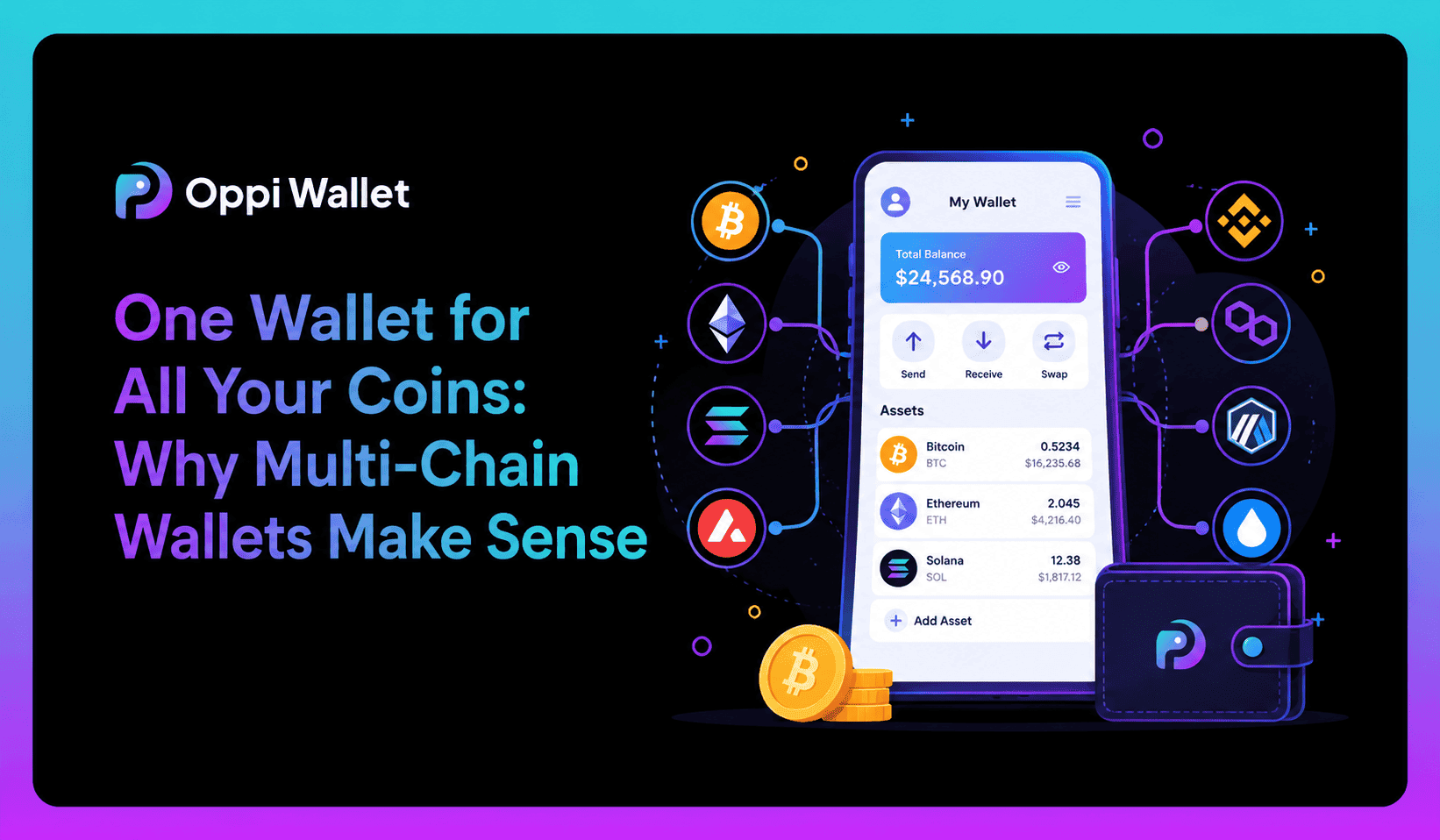
If you have been in the crypto industry, then you might be holding a few cryptocurrencies, and owning more than one cryptocurrency often means managing more than one wallet.
For this you might be having one wallet for Bitcoin, another for Ethereum and its tokens, and a separate app for Solana. Maybe another one for more than a network you tried out once and forgot about.
Each of these wallets comes with its own app, its own password, and its own recovery phrase. This is the set of words used to restore access to a wallet if you lose your device.
This should be familiar to anyone who has been involved in crypto for over a couple of months. One wallet for BitCoin. Yet another for Ethereum and its tokens. A single application for Solana. Perhaps one more for a network you used sometime and forgot about.
These are all accompanied by an application, a password and a recovery phrase, which is the collection of words that lets you regain access to a wallet if you lose your device.
It’s not only hard to manage, but also easy to make mistakes. It's risky since each additional wallet is an additional opportunity for something to go wrong.
This is what a multi-chain wallet solves. You're able to manage various crypto assets from a single unified interface, rather than using different apps.
In this guide, we will know the concept of a multi-chain wallet, its inner workings, and why it has become a convenient option for both beginners and crypto investors.
1. What Is a Multi-Chain Wallet?
Multi-chain wallets are crypto wallets that allow users to engage with and use multiple blockchain networks within a single application.
A multi-chain wallet allows you to manage assets on multiple chains from a single wallet, rather than having to download a separate wallet for each specific chain.
For that to make sense, it is important to understand the three terms that are often confused: coins, tokens, and blockchains.
A blockchain is the network used to power cryptocurrencies like Bitcoin, Ethereum, or Solana. Consider it is the system that processes and records every crypto transaction.
-
Each blockchain has a native coin, which is used to pay transaction fees on the blockchain. For example, Bitcoin uses BTC, while Ethereum uses ETH.
-
A token is an asset that is made on an existing blockchain, not on its own network. For example, USDT operates as a token on Ethereum and several other supported blockchains.
Most single chain wallets are designed to operate on a single chain.
A multi-chain wallet is built from scratch to support several blockchains in one wallet , meaning that you can hold your Bitcoin, your Ethereum tokens and your holdings on any of the other supported chains under one wallet app.
2. How Does a Multi-Chain Wallet Work?
A multi-chain wallet allows you to access and manage crypto on multiple blockchain networks through one wallet, so you don't need a separate wallet for each blockchain.
Even when you use the same app to access your Bitcoin address, Ethereum address, and any other network supported address, they are all different.
Actually, a wallet doesn't store your coins in the app. Your assets remain on the blockchain, while the wallet holds the keys needed to access and transfer them.
Most significant of these credentials is your private keys. Private key is a secret code that allows you to control your assets associated with a certain wallet address.
The person who has the private key controls the funds. Anyone who has your private key can access your funds, so it should always be kept secure and never shared.
When you create a wallet, including multi-chain wallets,you will receive a recovery phrase (also called a seed phrase). Typically, it's a series of 12 or 24 words that can restore your wallet to its original state, including your ability to access it from all the networks you've logged in to.
If you have a self-custody wallet, only you have access to your private keys and recovery phrase and nobody else has them, it is your responsibility. If they are lost or stolen, you may permanently lose access to your funds.
For more detailed information of how this model works, our guide on what is a self-custody wallet explains it better.
3. Common Misconceptions About Multi-Chain Wallets
Misconception 1: Multi-chain means the wallet should be capable of moving assets between chains
This is a very common misconception. Supporting several blockchain networks does not mean you can send assets directly from one network to another.
In fact, transferring an asset from one blockchain to another is called cross-chain functionality, and it is a totally different feature from the multi-chain wallet.
A multi-chain wallet ensures you store and control assets from multiple networks all in one application.
It's not a guarantee you can just use the same app to move from Ethereum to the Solana network and vice versa.
Misconception 2: Multi-chain wallet supports all networks and all tokens
A Multi-chain wallet is not a wallet that supports all chains, but a wallet that supports multiple chains.
Each multi-chain wallet offers a specific and list of supported blockchains and assets, which are diffrent across wallets.
It's important to note that not all wallets support every coin, token, or network, so make sure that the wallet that you are considering supports the coin, token, or network that you want to use before assuming that it does.
4. Why Managing Multiple Wallets Can Be Difficult
Before multi-chain wallets became common, using several blockchains often required separate apps. This made crypto harder to manage over time.
Too Many Apps and Accounts
Every additional wallet app adds another login, interface, and place to check your assets. Over time, it becomes difficult to remember which app holds which asset, especially if you do not use a particular network often.
Multiple Recovery Phrases
Each separate wallet usually comes with its own recovery phrase. Managing one recovery phrase carefully, meaning keeping it written down somewhere safe and never shared with anyone. Managing several phrases for each wallet increases the risk of losing, exposing, or confusing them.
More Complicated Transactions
Sending crypto requires picking the correct wallet, the correct address, and the correct network. When you are switching between multiple apps increases the risk of mistakes, which may lead to lost funds and impossible to recover.
Poor Portfolio Visibility
When your assets are on different apps, it is harder to view your total holdings. You end up manually opening several apps, calculating your holdings and recent transaction activity.
5. Advantages of Using a Multi-Chain Wallet
A multi-chain wallet provides several benefits.
The above problems are all solved with a multi-chain wallet because it integrates everything into one.
Here are some examples of this in action.
1. Manage Different Coins in One Place
A multi-chain wallet lets users manage and store crypto in one wallet across supported blockchain networks, through one interface without having to switch apps to check different assets.
2. Easy to Track Portfolio
All your assets on various chains are displayed in a single application, allowing you to check asset balances and view the transaction history without switching between separated wallets one after another.
3. Access Blockchain Applications
There are a number of blockchain networks that each have their own ecosystem of decentralised applications, or DApps, which operate on the blockchain instead of a single central company.
Multi-chain wallet can give you the ability to interact with the DApps from different networks without having to create separate wallets for each network.
4. Simpler Asset Transfers
It makes sending and receiving crypto assets easier because you can manage everything in one app instead of using a different wallet for each blockchain.
5. Better User Experience for Beginners
A multi-chain wallet is easier for beginners to use. It can be hard for a new crypto user to have to create a new wallet for each new blockchain before they've even purchased their first coin. Users can manage different cryptocurrencies from one app. This makes getting started with crypto easily and less confusing.
New to cryptocurrency, choosing the right wallet is just one part of getting started safely. Check out our guide on common crypto mistakes beginners make so you don't learn the hard way.
6. What are the potential users of a multi-chain wallet?
Multi-chain wallets can be beneficial for a wide variety of cryptocurrency users, and not just investors.
-
People who are not very on the technical side and prefer a simple alternative to manage crypto without learning multiple wallet apps.
-
Investors who hold different cryptocurrencies on multiple blockchain networks and want to manage them in one place.
-
Users of decentralised finance applications (DeFi) have to interact with several blockchain networks, often more than one.
-
NFT collectors, who buy and manage NFTs on different blockchain networks.
-
Any freelancer that has clients from globally, wants to receive payments in different cryptocurrencies around the world. A wallet with a virtual crypto card may also allow them to spend supported assets more easily.
-
For travellers and digital professionals who prefer quick access to their crypto while on the go without switching between multiple wallets.
-
Anyone who just wants to have less wallet applications that they are using in everyday life.
7. Multi-Chain Wallet vs Single-Chain Wallet
Both types of wallets are designed to solve the needs of crypto-users, but they come with their own set of uses.
Here is a side-by-side comparison of the two tables below.
|
Feature |
Multi-Chain Wallet |
Single-Chain Wallet |
|
Supported networks |
Several blockchain networks in one mobile application. |
Typically, a single blockchain network |
|
Ease of use |
The all-in-one solution for handling most assets. |
Needs different applications for different network providers |
|
Asset management |
The ability to view images across networks. Images can be viewed across networks. |
It can only be used with assets on one chain. |
|
Network-specific features |
May provide general assistance on chains |
Can provide more in-depth, network-specific tools |
|
Ideal users |
An overview of the most basics and multi-asset holders. Beginners and multi-asset holders. |
Different users who have an interest in one specific blockchain. |
For a more comprehensive comparison of the wallet options, you can read our guide to choosing a crypto wallet in 2026.
8. What to Look for in a Multi-Chain Wallet
In case you wish to add a multi-chain wallet, there are some things to take into consideration before starting.
-
Supported networks: Make sure your wallet actually works with the networks your coins or tokens live on. Not all wallets support every network, so double-check before you select.
-
Security features: Check if there are any biometric logins, two factor authentication and encrypted private key storage on your device.
-
Non-custodial wallet: This is a wallet that you keep yourself instead of a company keeping your private keys for you.
-
Easy to use: It should be simple to use, particularly for people who are new to managing crypto assets on a number of networks.
-
Application support: If you are going to use any decentralised apps, such as DeFi platforms, or any NFT marketplaces, you should determine whether the wallet can connect to these applications.
-
Regular updates: Blockchain technology and network standards are continually evolving, so it is important that they are actively developed.
-
Customer support: If you get into any problem related to the transaction or your account, you will be able to take advantage of responsive customer support.
-
Devices Availability: See if the wallet is available to devices that you use, like on mobile devices or in a desktop browser.
Setting up a crypto wallet is easier than you think.
This is the step-by-step guide on how to set up a crypto wallet in 10 minutes from download to your first transaction.
9. Final Thoughts
The concept of multi-chain wallets was born because people felt it was no longer profitable to maintain multiple crypto wallets for multiple applications.
Whether you are new to crypto or an existing user with multiple assets across several networks, having all of your assets, transactions and portfolio view in one place truly makes crypto easier to use.
However, convenience and simplicity should not compromise security.
Ready to manage your crypto with Oppi Wallet.
Download the app now on iOS or Android. Multiple blockchain networks support all in one wallet app.
10. FAQs
Is it possible to store multiple cryptocurrencies in the same wallet?
Yes. Multi-chain wallets allow users to store and control multiple cryptocurrencies and tokens as long as the blockchain network that they operate on supports them.
What is the difference between a multi-chain wallet and a cross-chain wallet?
Not exactly.
-
Multi-chain wallet: You can operate multiple blockchain networks in a single wallet.
-
A more specific use of a cross-chain wallet is transferring assets directly from one blockchain to another.
Is using a Multi Chain Wallet safe?
Their safety depends on how they build and use wallets. Be sure to look for non-custodial control, encrypted private key storage, and other elements, such as two-factor authentication, and always keep recovery phrases somewhere safe.
Is it possible to hold bitcoin and ethereum in the same wallet?
Yes, if the multi-chain wallet has both Bitcoin and Ethereum network support. Each will usually have its own address in the wallet.
Are there any fees associated with multi-chain wallets?
While some multi-chain wallets impose their own fees, others do not, the fees are usually charged by the blockchain networks themselves, not the wallet. Before making any transactions, always check the fee structure of any wallet.
What happens if I select the wrong blockchain network?
It is possible to send a transaction to wrong blockchain network, which could be the cause of a failed transaction or in some cases, loss of funds. This is one of the risks a multi-chain wallet helps you avoid by having network selection in one interface.
Is it better to use a multiple-chain wallet or many wallets?
Generally, a multi-chain wallet is easier and simpler to operate for most users who have assets in several different blockchains. If these users only use a single blockchain, they might prefer a different blockchain wallet.